
AT-A-GLANCE
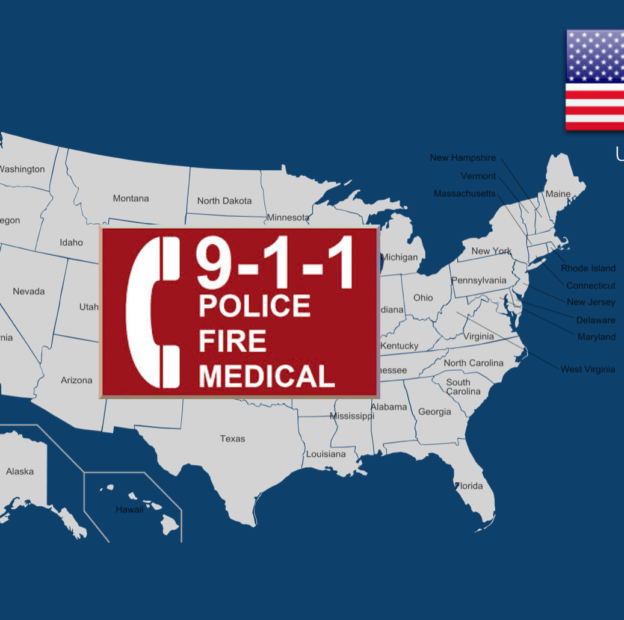
DIAL 911 TO CALL AN AMBULANCE IN THE USA
- 911 connects callers to EMS, Fire and Police
- The US offers 24-7 access to emergency medical services across most of the country — even in the most rural areas dialing 911 will get you in touch with the nearest emergency responders
- The US has one of the most fragmented EMS systems in the industrialized world, with over 20,000 individual agencies nationwide, each with a special way to do things just a little bit differently than the rest
- System organization and care delivery managed at the state and local levels with potentially considerable differences in standards of care from city to city
- Ambulances are staffed overwhelmingly by “physician surrogates” – i.e., EMTs and Paramedics who are trained to deliver basic and advanced emergency care under a physician’s medical direction
- Ambulance charges are paid by private insurers, government insurance (for the poor, elderly and disabled) or paid out-of-pocket; foreigners may be surprised to find themselves with a substantial bill after taking an ambulance
HOW CAN I CALL AN AMBULANCE IN THE USA?
Dial 911 in case of emergency for EMS, fire or police
Yes, 911 is available to 99% of population; 96% of geography. When calling 911 the caller will be connected to an Emergency Medical Dispatcher (EMD) who is a formally trained call-taker and whose role is to answer calls from public and communicate with response units in field. When calling 911 the EMD will gather information from the caller — including the location of the call and the nature of the emergency — and may also provide pre-arrival instructions over phone (e.g., how to check a pulse, perform CPR, calming measures et al).
Other numbers that may be mentioned are 311 or 411, which are available in some states and were designed to make available information for non-emergency incidents.
Depending on the state and/or community, additional “hotlines” may be available, including suicide prevention hotlines and poison control centers. However, owing to national efforts to streamline public access to emergency services, coupled with a robust tradition of litigation in the US, designated healthcare providers like hospitals, insurance companies, pharmacies and poison control centers will instruct callers with life- or limb-threatening emergency situations to hang up and dial 911 immediately.
Disaster response efforts and communications in the US are maintained at the local level. In case of an emergency in a disaster situation, you are still instructed to call 911. A range of local, county, state and national response agencies may become involved in response operations and may be used to disseminate information to the public, but requests for urgent medical assistance will remain accessible through 911.
Here’s a list of useful links for federal agencies involved in disaster response:
Yes, American EMS providers are trained in four distinct levels of care. Though these levels of care vary from state to state, the National Registry of Emergency Medical Technicians (NREMT) is generally recognized as the standard-bearer for EMS training, whose accreditation process is “utilized to validate competent practice by EMS professionals.”
- Emergency Medical Responder (or, Certified First Responders): Most commonly employed/affiliated with local public safety agencies; 40-50hrs of training, including:
- Basic First Aid
- CPR and AED
- Uncomplicated Obstetric Delivery
- Basic Wound Management
- Fracture Immobilization (including spine)
- Emergency Medical Technician (or EMT-Basic): majority staffing level of US ambulances; typically consists of a 120-hour course
- First-Responder training
- Oxygen administration
- Scene Triage
- Patient Extrication
- Patient Transfer
- Rural exceptions (in general):
- Tracheal intubation
- Transport of Pt’s receiving IV crystalloid fluids
- ASA in Acute Coronary Syndrome
- Nitroglycerine
- Inhaled Bronchodilators
- Epi Autoinjectors
- Advanced EMT (or, EMT-Intermediate): level of training and local regulations vary greatly, but training courses generally require 320 hours and include:
- IV lines (w/possible first-line cardiac meds)
- Tracheal Intubation
- Cardiac Monitoring
- Manual Defibrillation
- Paramedic (or, EMT-Paramedic): highest level of training; national curriculum, though program components vary depending on locale; typically >1000hrs
- IV access
- Medication Administration
- Advanced Airway Techniques
- Tracheal Intubation
- Needle Cricothyroidotomy
- Needle Thoracostomy
- Cardiac Monitoring
- Manual Defibrillation
- 12-Lead Interpretation
- Thrombolytics (being studied)
- Additional Training
GROUND AMBULANCE IN THE USA
patients will be transported by a conventional ambulance. Ambulance standards are determined by the federal government (Department of Transportation) and known as the KKK-1822 standards, and include:
- TYPE I AMBULANCE – a cab chassis furnished with a modular ambulance
- TYPE I – AD (ADDITIONAL DUTY) AMBULANCE – a Cab-Chassis with modular ambulance body, increased GVWR, storage, and payload.
- TYPE II AMBULANCE – a long wheelbase Van, with Integral Cab-Body
- TYPE III AMBULANCE – a Cutaway Van with integrated modular ambulance body.
- TYPE III – AD (ADDITIONAL DUTY) AMBULANCE – a Cutaway Van with integrated modular body, and increased GVWR, storage, and payload.
AIR AMBULANCE IN THE USA
In urban, suburban and rural areas, helicopters are also commonly used. In a few progressive 911 systems, police cruisers may be used to transport certain patients with life-threatening injuries when determined that waiting for the ambulance will take longer than transporting directly to the hospital.
In general, American EMS systems used a tiered response system:
- Most common is where the fire department and/or police department act as First Responders and provide basic (and sometimes advanced) life-saving interventions (e.g., airway management, bleeding control, CPR etc.)
- These first responders are then typically followed by prehospital care providers in one of two types of ambulances:
- Basic life support (BLS) ambulance, staffed and equipped at the EMT-Basic level
- Advanced life support (ALS) ambulance, staffed and equipped for the EMT-Paramedic level
In the US, patients are not always transported to the nearest hospital. In highly-populated areas there are often available specialty centers devoted to specific medical conditions. For this reason, the nearest hospital may be bypassed by the ambulance crew in order to deliver the patient to a more appropriately-equipped treatment facility, including:
- Trauma Centers
- Cardiac Centers
- Pediatric Centers
- Burn Centers
There are three ways that ambulance services are typically paid for in the United States:
- Private health insurance
- Government health insurance (Medicare or Medicaid)
- Out-of-pocket payments
Charges and rates vary from city to city, but generally include charges for:
- Staffing
- Type and levels of care provided
- Mileage
ADDITIONAL INFO
Common Emergencies in the USA
- Road traffic injuries
- Security threats
- Interpersonal violence
- Natural disasters (regional)
- Earthquakes (predominately on west coast)
- Floods (predominately in the midwest)
- Tornadoes (predominately in the midwest and south)
- Wildfires (predominately in the midwest and west coast)
- Hurricanes (predominately along the eastern seaboard)
- Blizzards (predominately in the west, midwest and northeast)
Recommended Vaccinations for the USA
According to the US Centers for Disease Control and Prevention (CDC), there are no required vaccinations for travel to the United States.
- 1860s – In US Civil War, ambulance services were implemented very effectively to collect and transport Union soldiers wounded on the battlefield; “however, a lack of money, governmental support, and dedicated personnel prevented any initial success” (Pozner, 240)
- 1865 – Commercial Hospital of Cincinnati (Cincinnati General): First civilian-run, hospital-based ambulance service
- Bellevue Hospital (NYC): First municipal-based EMS
- Chicago Fire Dept: Established First-Aid Training Program which became prototype for modern EMT training program
- 1966 – “The White Paper”:Accidental Death and Disability: the neglected disease of modern society
- Released by the National Academy of Sciences (NAS)
- Outlined inadequacies of prehospital and ED care in US
- Prescribed 24 recommendations for improvement
- Became stimulus for federal gov’t to create organized EMS and trauma system.
- Highway Safety Act: response by feds to NAS paper, creating U.S. Dept. of Transportation (DOT)
- Charged with improving EMS in US, developing 70hr basic EMT curriculum
- ALS curriculum created years later
- Wedworth Townsend Act of 1970: signed by Ronald Regan (Gov.) for EMS in CA
- “Permitted paramedics to act as physician surrogates providing advanced-level care under direction of off-site physicians” (Pozner, 240)
- Prior to law, paramedics required nurse/physician present in ambulance to administer meds
- Subsequent acts passed throughout nation
- EMS Act of 1973: intended to improve and coordinate EMS throughout US
- Provided millions of dollars for training, equipment and research.
- Identified 15 essential components in development of EMS system:
- Personnel
- Training
- Communication
- Transport
- Emergency Facilities
- Critical-Care Units
- Public Safety Agency
- Consumer Participation
- Access to Care
- Patient Transfer
- Standard Record Keeping
- Public Teaching/Education
- System Review/Evaluation
- Disaster Planning
- Mutual Aid
- “EMS development progressed in a disorganised manner resulting in a heterogeneous mosaic of systems with varied successes, some of which met the intended goals, others falling short” (Pozner, 240)
- 1981 – Omnibus Budget Reconciliation Act: “effectively brought an end to the golden era of EMS” (Pozner, 240)
- Rearranged federal funding so that each state was charged with appropriating funds as they best saw fit
- Reallocation of funds to different areas resulted in substantial budget cuts
- Significantly reduced federal involvement in EMS care
- Created nearly complete reliance on state/local initiatives to fund EMS development
- Perpetuated further fragmentation of national EMS systems
The United States, and particularly its health system, prides itself on local management of services. Though the Federal Government has designated the National Highway Traffic Safety Administration (NHTSA) as the lead federal agency (housed within the Department of Transportation), actual oversight is left to individual states, who, in many cases, delegate authority to county or municipal health departments.
Visit the NREMT website for a useful map of state EMS agencies including contact info and licensure/certification requirements.
- “EMS Agenda 2050: Envision the Future” (Website)
- National Highway Traffic Safety Administration: “EMS Agenda for the Future” (1996)
- Pozner CN, Zane R, Nelson, SJ, Levine M. “International EMS Systems: The United States: past, present, and future.” Resuscitation 2004;60:239-44.
Official EMS Resources
- EMS.gov (Federal website
- National Association of EMTs (NAEMT) – “the nation’s only organization solely dedicated to representing the professional interests of all EMS practitioners”
- National EMS Information System (NEMSIS) – “the national database that is used to store EMS data from the U.S. States and Territories”
- National Registry of Emergency Medical Technicians (NREMT)
Articles of Interest
- “Air Ambulances Offer a Lifeline, and Then a Sky-High Bill” – The New York Times (May 5, 2015)
- “When You Call 911 and Wall St. Answers” – The New York Times (June 25, 2016)
EMS Publications
SCOREBOARD
% of Seriously Injured Transported by Ambulance in the USA, 2013
[Source: 2013 Global Status Report on Road Safety, WHO]
ROAD TRAFFIC INJURY DEATHS, 2015
(PER 100,000 POPULATION)
[Source: 2015 Global Status Report on Road Safety, WHO]
REPORTED HOMICIDES, 2012
(PER 100,000 POPULATION)
[Source: 2014 Global Status Report on Violence Prevention, WHO-UNDP]