

AT-A-GLANCE
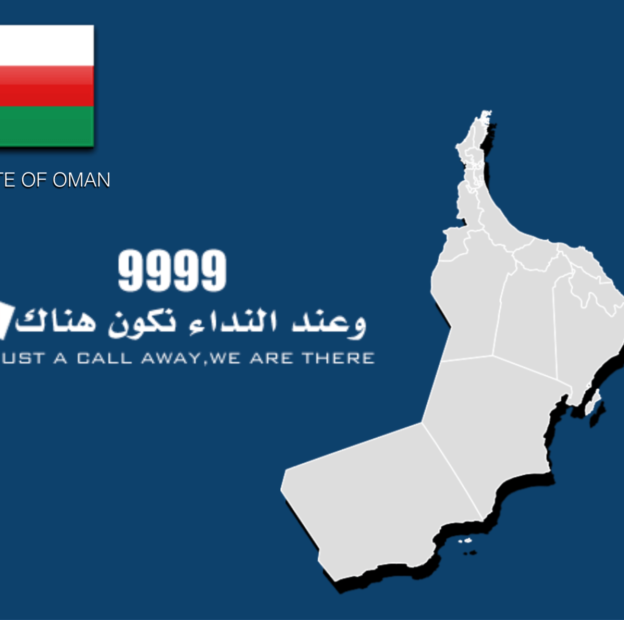
DIAL 9999 TO CALL AN AMBULANCE IN OMAN
- It’s also possible to call 112, but those calls will be re-directed to the 9999 call center [Source: Royal Omani Police quote]
- Emergency medical services are managed by the Royal Omani Police through the Public Authority for Civil Defense and Ambulance (PACDA)
HOW CAN I CALL AN AMBULANCE IN OMAN?
Dialing 9999 will connect you to the central public service call center who takes initial information and then forwards it to the nearest appropriate service. As of 2009, there was no medical assistance provided by dispatchers to callers.
Not necessarily. Ambulance stations are regionalized, making the accessible to a wider population, but as of 2009 there were 23 permanent ambulance units serving >70% of Omani population with an additional five temporary units activated during summer Salalah Festival (Khalifah 2009).
[Verifiable info not available]
Yes, personnel staffing the ambulance in Oman are trained to an advanced emergency medicine technician (AEMT) level. (Khalfia 2009)
- Course Requirements:
- Completed general science secondary school certificate with 70% or above grade.
- Physically and medically fit.
- Never been convicted / have a criminal record
- After passing the recruitment process the training program for AEMTs is divided into three periods:
- First period: 6 months, covers basic police sciences and police training. This period is spent at the Sultan Qaboos Academy of Police Sciences
- Second period: foundation lasting one year; covers English language, anatomy and physiology, and basic computer sciences.
- Third period: one-year period of specialized training. This is divided into three semesters of 16 weeks each:
- A – 1st semester: trauma and patient assessment.
- B – 2nd semester: medical emergencies and patient assessment.
- C – 3rd semester: special cases and selected topics.
- Written and practical examinations after each semester
- Linked to tertiary hospitals to further expose them to emergency cases and skills practice
- Graduates given Field Preceptors (senior AEMTs) for 6-8 months prior to field assignment
- Instruction
- Provided by specialized Omani instructors trained by international EMS institutes
- American Heart Association (AHA)
- US National Association of EMTs (NAEMT)
- Courses were originally adopted from US-NHTSA EMT-Paramedic curriculum and include BLS, ACLS, BTLS, PHTLS, PALS, and other emergency care courses
- Provided by specialized Omani instructors trained by international EMS institutes
TRANSPORT BY GROUND AMBULANCE IN OMAN
Ambulances are “very modern and equipped with excellent equipment and state of the art supplies” meeting the American KKK-A ambulance specifications (Khalifah 2009).
TRANSPORT BY AIR AMBULANCE IN OMAN
Access to helicopters in the Omani EMS is possible.
Here’s a list of hospitals and health centers in Oman. [Source: Royal Omani Police website]
| Royal Oman Police Hospital | 24603988 |
| Sultan’s Armed Forces Hospital | 24337997 |
| Sultan Qaboos University Hospital | 24147777 |
| Royal Hospital | 24599000 |
| Khoula Hospital | 24563625 |
| A’ Nahdha Hospital | 24837800 |
| A’ Rahmah Hospital | 24815132 |
| Al Masara Hospital | 24873268 |
| Quriyat Hospital | 24845003 |
| Sultan Qaboos Hospital – Salalah | 23216100 |
| Taqa Hospital | 23258041 |
| Rakhyot Hospital | 23200006 |
| Sadah Hospital | 23277016 |
| Tawi Atir Hospital | 23283773 |
| Madinat Al-Haq Hospital | 23282442 |
| Umm Al Ghawrif Hospital | 23265000 |
| Al Buraimi Hospital | 25650855 |
| Yanqul Hospital | 25672055 |
| Wadi Al-Jizzi Hospital | 25668033 |
| Ibri Hospital | 25691990 |
| Tanam Hospital | 25699033 |
| Nizwa Hospital | 25211331 |
| Sumail Hospital | 25352236 |
| Izki Hospital | 25340033 |
| Bahla Hospital | 25419233 |
| Al-Jabal Al-Akhdar Hospital | 25429279 |
| Adam Hospital | 25434167 |
| Sohar Hospital | 26840399 |
| Saham Hospital | 26855148 |
| Wadi Hibi Hospital | 26848818 |
| A’ Rustaq Hospital | 26877186 |
| Wadi Bani Ghafir Hospital | 26898100 |
| Wadi Al-Hamli Hospital | 26765199 |
| Wadi Bani Kharoos Hospital | 26874212 |
| Wadi Mistel Hospital | 26873310 |
| Sur Hospital | 25561373 |
| Ja’lan Bani Bu Ali Hospital | 25553011 |
| Ja’lan Bani Bu Hassan Hospital | 25551055 |
| Masirah Hospital | 25504654 |
| Ibra Hospital | 25587100 |
| Sinaw Hospital | 25524143 |
| Badiya Hospital | 25583998 |
| Samad A’shan Hospital | 25526344 |
| Dima Wa’taeen Hospital | 25560047 |
| Wadi Bani Khalid Hospital | 25505400 |
| Khasab Hospital | 26730148 |
| Diba Hospital | 26836443 |
| Bukha Hospital | 26828562 |
| Bousher Health Complex | 24593311 |
| Haima Hospital | 23436421 |
| Al Duqm Hospital | 25415276 |
| Al-Jazer Hospital | 92814127 |
| Mahoot health center | 25427400 |
The emergency medical services are funded entirely by Royal Oman Police and provided free of charge, regardless of insurance status.
ADDITIONAL INFO
Common Emergencies in Oman
- Road traffic crashes – approximately 10,000 per year (Al-Lamki 2010)
- Security threats, specifically from neighboring Yemen’s ongoing civil war
- Earthquakes
- Tropical cyclones
- Flash flooding
Vaccinations for Oman
According to the US Centers for Disease Control and Prevention (CDC), different groups of travelers will require different vaccinations for travel in Oman:
- All Travelers
- Measles-mumps-rubella (MMR) vaccine
- Diphtheria-tetanus-pertussis vaccine
- Varicella (chickenpox) vaccine
- Polio vaccine
- Your yearly flu shot
- Most Travelers
- Hepatitis A
- Typhoid
- Some Travelers
- Hepatitis B
- Malaria
- Rabies
- Yellow Fever
Read more about travel in Oman at the CDC website: https://wwwnc.cdc.gov/travel/destinations/traveler/none/oman/ (Last accessed: Aug. 7, 2017)
1985 (June) – EMS planning first initiated by government
1986 – Formation of EMS national committee
1991 – Public Authority of Ambulance Services (PAAS) established
2000 – program reactivated under Royal Oman Police (ROP)
- Joint committee between ROP and MOH formed for development of modern EMS system
2001 – Ambulance Division Project Committee formed
- Group of Omani MDs and RNs from various specialties sent to Ronald Regan Institute of Emergency Medicine to formulate advanced emergency medical care training program
- Trained as instructors and set standards for Omani EMS
2004 – April 6th: EMS System officially launched
- Personnel qualified to AEMT level
- Scope originally directed towards trauma and injuries
- Has since expanded to all medical emergencies
The Royal Oman Police oversee emergency medical services and transport by ambulance in Oman through the Public Authority for Civil Defense and Ambulance.
- Al-Lamki, L: “Life Loss and Disability from Traffic Accidents; It is imperative we all act now.” Sultan Qaboos University Medical Journal 2010;10(1): 1-5.
- Khalifah Al-Shaqsi SZ: “EMS in the Sultanate of Oman.” Resuscitation 2009;80(7):740-2.
- Sultan Z Al-Shaqsi: “Emergency management in the Arabian Peninsula: A case study from the Sultanate of Oman,” PhD paper., University of Otago Dunedin School of Medicine, New Zealand, 2010. Available at: https://pacdaoman.gov.om/images/pdf/research/DrSultan-Al-shaqsi.pdf
SCOREBOARD
% of Seriously Injured Transported by Ambulance in Oman, 2013
[Source: 2013 Global Status Report on Road Safety, WHO]
Road Traffic Injury Deaths, 2015
(per 100,000 population)
[Source: 2015 Global Status Report on Road Safety, WHO]
Reported Homicides, 2012
(per 100,000 population)
[Source: 2014 Global Status Report on Violence Prevention, WHO-UNDP]