
AT-A-GLANCE
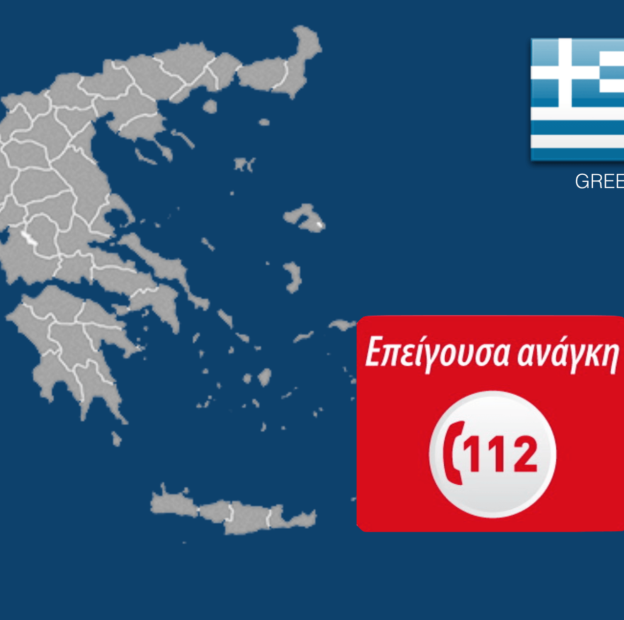
DIAL 112 or 166 TO CALL AN AMBULANCE IN GREECE:
- Emergency medical services are run by the Hellenic National Centre for Emergency Care (EKAB)
- EKAB received close to 1.7 millions calls in 2016, responds to approximately 320,000 calls per year in Athens metropolitan area alone
- EKAB has helicopter ambulances in three locations to respond and transport patients from 200+ inhabited islands
HOW CAN I CALL AN AMBULANCE IN GREECE?
DIAL 112 TO CALL AN AMBULANCE IN GREECE
112 is a toll-free number that can be accessed from across the country. Dialing 166 is also still possible.
Central offices are in Athens with 11 other regional coordinating centers in major cities, covering over 95% of urban population
- Each station has own:
- Personnel
- AdministrationCommunication
- Dispatch Centers
- MDs and EMTs
- Ambulance Cars
- Medical Equipment
Yes, the former emergency access number in Greece 166 is still promoted by government agencies. According to the EKAB website:

You can call 166 from any phone free of charge, from a mobile, fixed or even a cardless cardless card slot.
State the phone number (mobile or fixed) from which you are calling.
State the area you are calling from (eg city / village etc).
State the exact address and a characteristic point (eg church – school, etc.) to find your ambulance more easily and quickly.
Say how many victims are there (if it is a traffic accident or other).
Do not close the phone first! Ask your EKAB operator, if you need some other information, you may need more information than you gave and wait for that phone to close first.
We understand that your frustration and inconvenience may be justified, but try to stay calm. We need your help to help you better.
English text via Google Translate plug-in
In disasters, 112 / 166 call centers are responsible for communication with other institutions, including the fire department, police department and military, and are coordinated through the Special Department of Medical Disasters (ETI).
- 1987 – Training Center established
- Education centers founded at almost all EKAB stations
- Also offer Continuing Training Courses for EMTs, nurses, doctors and others, including PHTLS, BLS/AED
- Government-funded training, free of charge
- EMT-Basic training program introduced under regulation of Ministry of Health (1989) – 1 year; 1,000 hours teaching
- As of 2000 – more advanced education instituted for EMTs — 2 years; 1,400 hours: 800 hours theory; 600 hours clinical/field
- Prehospital Physicians
- 1995 – 1 year; 400 hours training course for doctors in prehospital emergency medicine; 75 hours classroom; 25 hours workshops; 300 hours clinical
- Post-Graduate Diploma awarded
- Course free of charge
Ground Ambulance in Greece
Response and transport vehicles are delivered through a two-tier system using motorcycles and ground ambulances. In major cities, motorcycles are used to improve provision of rapid medical care, able to maneuver more quickly through traffic congestions and along narrow (ancient) city streets:
- Mobile intensive care units (MICUs)
- Specially-equipped motorcycles
- Specially-equipped super-mini city cars
- Basic life support (BLS) ambulances.
“The crew of the MICUs, motorcycles, and super-mini cars includes a medical doctor, together with two paramedics (one on motorcycle), whereas the BLS ambulance crew consists of only two paramedics (personnel who received two- year special training in prehospital care)” (Togia, 2008)
“Use of motorcycles seems to be more efficient in the context of a densely populated metropolis, as the response interval is significantly shorter. On the contrary, BLS ambulances need the longest time to arrive on-scene. However, BLS ambulances stay on-scene for a shorter interval, as, contrary to motorcycles, MICUs, and super-mini city cars, they are unable to provide advanced medical care.” (Togia, 2008)
In 2016, the first 90 of 167 BLS-equipped ambulances and 19 MICUs were delivered to EKAB central offices, as part of a multi-year tender, to be delivered to 8 of 13 regions. The EKAB administration had reportedly sped up the procurement process “in order to ensure the fuller provision of urgent pre-hospital care to the region which – especially at this time – is burdened by the emerging needs arising from refugee flows.” The funding was provided by the Stavros Niarchos Foundation through a grant for 14 million Euros awarded in April 2017 to allow “the procurement of 143 state-of-the-art ambulances as well as their full service and maintenance for a period of 8 years and the digital upgrade of its operations center.”
Air Ambulance in Greece
Three helicopter ambulances are owned by Ministry of Health and operated by Air Force (who have additional helicopters and airplanes). Over 95% of helicopter transports come from islands: “EKAB is the sole public organization responsible for all actions necessary to transport critical patients from all corners of the country to the appropriate definitive care facilities.” [Source: EKAB Presentation] However, funds to repair and maintain the helicopters ground them in 2016.
ADDITIONAL INFO
Common Emergencies in Greece
- Road traffic injuries
- Security threats
Recommended Vaccinations for Greece
According to the US Centers for Disease Control and Prevention (CDC), different groups of travelers will require different vaccinations for travel in Greece:
- All Travelers:
- Measles-mumps-rubella (MMR) vaccine
- Diphtheria-tetanus-pertussis vaccine
- Varicella (chickenpox) vaccine
- Polio vaccine
- Your yearly flu shot
- Most Travelers:
- Hepatitis A
- Hepatitis B
- Typhoid
Read more about travel in Greece at the CDC website: https://wwwnc.cdc.gov/travel/destinations/traveler/none/greece/ (Last accessed: Aug. 7, 2017)
- 1915 – First Aid station situated next to Parliament in Athens established – “Sotir” (Saviour)
- 1932-1988 – Hellenic Red Cross founded first aid stations with own ambulances across country
- 1965 – Social Insurance Institute (IKA) created first aid stations with own ambulances in parallel with Samaritans
- 1975 – Center for Emergency Care (KAB) founded within Athens General Hospital
- “166” – Access Number
- Different numbers for Hellenic Red Cross and IKA
- 1986 – Personnel and Equipment of IKA and Red Cross first aid stations merged into KAB
- “166” became common access national telephone number
- Ethniko Kentro Amesis Boitheias (EKAB) – Greek EMS, Est. 1987 by national law (1985)
- Free of charge for all citizens
- Doctors involved at all levels
- Substantial emphasis is put on education for prehospital emergency care providers
- 2003 – Law passed governing organization and operation of EDs in public hospitals with >200 beds
Lead Agency: Ethniko Kentro Amesis Boitheias (EKAB) – Subordinate of Ministry of Health
- Markogiannakis H et al: “Motor vehicle trauma: analysis of injury profiles by road-user category.“ Emerg Med J 2006;23:27–31.
- Papaspyrou E, Setzis D, Grosomanidis V, Manikis D, Boutlis D, Ressos C: “International EMS Systems: Greece.” Resuscitation 2004;63:255-9
- Togia A et al: “Drug Abuse-Related Emergency Calls: A Metropolis-Wide Study.“ Prehosp Disaster Med 2008;23(1):36-40.
SCOREBOARD
ROAD TRAFFIC INJURY DEATHS
(PER 100,000 POPULATION)
[Source: 2015 Global Status Report on Road Safety, WHO]
REPORTED HOMICIDES
(PER 100,000 POPULATION)
[Source: 2014 Global Status Report on Violence Prevention, WHO-UNDP]