

AT-A-GLANCE
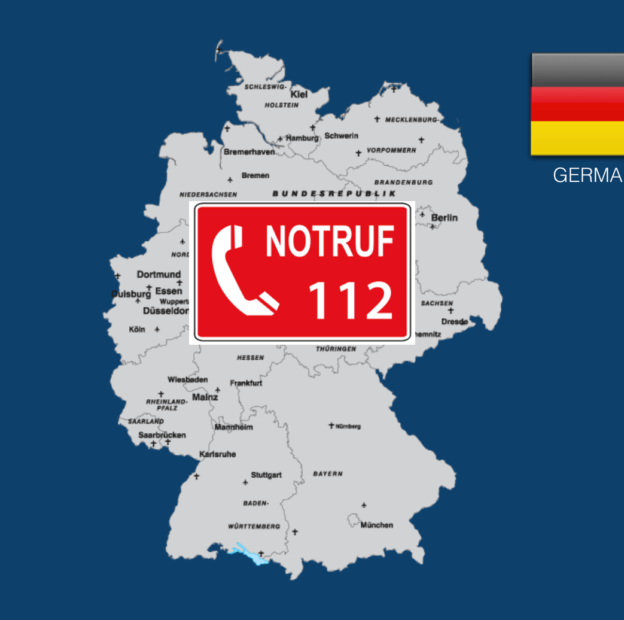
IN CASE OF EMERGENCY: DIAL 112
HOW CAN I CALL AN AMBULANCE IN GERMANY?
The toll-free number for emergency services in Germany is 112.
German regulation requires that EMS has to be guaranteed to arrive at scene within 10-15mins of dispatch
Yes, mostly. 80% of call centers coordinate EMS, non-ambulance transport and fire brigade (Police have own dispatch). After calling, dispatchers will determine the patient’s condition and triage the call in order to determine whether they will send the ambulance, a physician-staffed response unit or both.
Yes, in Germany there are two kinds of medical professionals that staff ambulances – physician and non-physician:
- Non-Physician Personnel
- Rettungshelfer (RH):
- 160 hours class; 80 hours practical
- Focus on resuscitation and emergency medicine
- Mostly found as unpaid volunteers at public events/non-emergency transport
- Rettungssanitäter (RS):
- 160h class; 160h clinical; 160h practical training
- Most common level of training until 1989
- Rettungsassistent (RA):
- Replaced RS as formal qualification required
- 2 yrs training
- 1st yr: 1200h theoretical/practical
- 2nd yr: 1600h apprenticeship in ambulance service
- Most German states require that each ambulance has at least one experienced RS and on RA, preferably two RA
- None are authorized formally to:
- Administer Meds
- Establish IV access
- Defibrillate
- Perform Tracheal Intubation
- “Emergency Competence” – Common practice/procedure to perform these skills if MD is not immediately available on-scene and procedure is necessary to treat life-threatening condition, includes:
- Defibrillation
- Peripheral IV access
- ET Intubation w/o relaxants/anesthesia
- Crystalloid fluid infusion:
- Isotonic NaCl, Lactated Ringers
- Drug administration:
- Glucose
- Epinephrine
- Diazepam
- Inhaled b2-adrenergics
- Nitrate Spray
- Rettungshelfer (RH):
- Emergency Physicians
- Intensive additional training in EMS
- Most work part-time, with roots in anesthesia, surgery/orthopedics or internal medicine
- On-scene, MD can provide all necessary interventions
- ALS
- Thrombolysis
- Antiarrhythmics
- Strong analgesics
- Anesthesia and intubation
- Ventilation
- Reduction of dislocations/fractures
- Chest drainage
- Minor cases dealt with on-scene, preventing unnecessary hospital admissions
- All regions required to have lead MD on-call to coordinate EMS response in MCI’s
Dispatchers determine the type and severity of the call during interrogation and then determine if the caller requires care at home or will need transport to hospital. This allows for two types of prehospital care providers to be available and thus reduce response times:
- Stationary units, which are conventional ambulances staffed with doctors
- Rendezvous units, which are regular automobiles driven by doctors and equipped with most all of the same equipment but no transport capability, making it a more flexible response unit, and active in 87% of systems (Roessler, 2006)
Ratio of 3:1 or 4:1 non-physician-staffed ambulances to physician-staffed vehicles
ADDITIONAL INFO
Ambulance services in Germany are overseen by the state health ministries, though much of the responsibility is delegated locally:
- Ground ambulance agencies are the responsibility of local communities and cities
- Helicopter ambulances are the responsibility of the states, though often nonprofit organizations are commissioned to deliver air service (e.g., German Red Cross, etc.)
- 1881 – Johann Friedrich von Esmarch launched initiative for first aid education to laypersons
- Ernst von Bergmann established prehospital EMS in Berlin at end of 19th Century
- Stretchers affixed to hand wheelbarrow for transportation of sick/injured
- 1908 – First International Congress for Prehospital Emergency Medicine
- Ambulance services supervised by physicians
- Attend Pt’s on-scene
- Martin Kirscner (surgeon), 1938: “The injured should not come to the physician, thephysician should go to the injured”
- 1957 – Viktor Hoffmann MD decided that only immediate life-threatening Pt’s should be treated on-scene
- 1966 – Friedrich Wilhelm Ahnefeld formulated “Chain of Survival” concept
- 1989 – national certified training scheme for ambulance personnel confirming occupation as a profession
- Boyle MJ, Smith EC, Archer FL: “Trauma incidents attended by emergency medical services in Victoria, Australia.” Prehospital and Disaster Medicine 2008;23(1):20-8.
- Trevithick S, Flabouris A, Tall G, Webber CF: “International EMS systems: New South Wales, Australia.” Resuscitation 2003;59:165-70.
SCOREBOARD
% of Seriously Injured Transported by Ambulance
[Source: 2013 Global Status Report on Road Safety, WHO]
ROAD TRAFFIC INJURY DEATHS
(PER 100,000 POPULATION)
[Source: 2015 Global Status Report on Road Safety, WHO]
REPORTED HOMICIDES
(PER 100,000 POPULATION)
[Source: 2014 Global Status Report on Violence Prevention, WHO-UNDP]