

AT-A-GLANCE
DIAL 15 or 112 TO CALL AN AMBULANCE IN FRANCE:
- France runs a sophisticated emergency medical system known as “SAMU” (Service d’Aide Médicale Urgente) which puts an emphasis on treating patients at the point of contact prior to transport
- Ambulances are staffed by specialist physicians and nurses
- The French Fire Brigade (Briagde des Sapeurs-Pompiers [BSPP]) also staffs and operates ambulances with “paramedics” who are trained to a US-equivalent EMT-Basic (Hamada 2014)
HOW CAN I CALL AN AMBULANCE IN FRANCE?
IN CASE OF EMERGENCY:
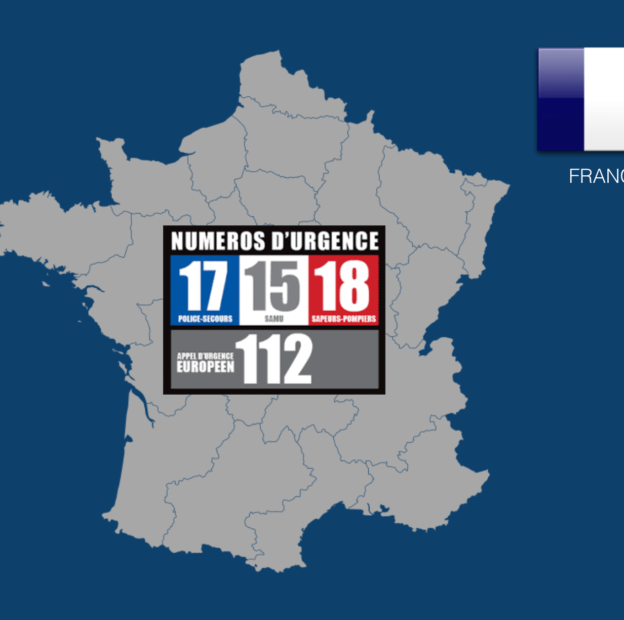
- Dial 15 for Ambulance (“SAMU”)
- Dial 17 for Police
- Dial 18 for Fire Department
- or Dial 112 , the Europe-wide emergency number, which will route your call to the nearest Fire Department or SAMU call center, depending on the caller’s geographic location
Yes. The French SAMU system is accessible throughout France.
- Single Access national telephone number
- 112 – emerging universal European number for emergency assistance)
- 15 for SAMU, and 18 for VSAB are legacy numbers, still in use
- Dispatch Center with switchboard operators and physicians situated in major hospital in given medical region.
- Switchboard operators forward calls to dispatching physician
- MD determines appropriate level of response
- Dispatcher can provide CPR/Heimlich assistance by phone
- Dispatching MD determines destination or specialized service required.
- Keeps track of:
- Bed availability
- Specialty hospitals available on predetermined schedule
- All MDs work full-time, 24h shifts
- Keeps track of:
- Switchboard operators forward calls to dispatching physician
Dial 112 to request emergency assistance during a disaster or complex emergency in France. You can also call 15 (ambulance), 17 (police) or 18 (fire department), but calling 112 will ensure that French dispatchers are able to send the appropriate resources in any emergency type.
In the past couple years France has suffered a number of deadly terrorist attacks, leading to renewed focus on their emergency response capabilities:
“After the Paris attack, the French emergency medical services asked the French Military Medical Service to transfer their expertise into the civilian setting. …Since the Paris attacks, the French authorities and emergency medical services have organised, at the national and regional levels, teaching of civilian surgeons, anaesthesiologists, and emergency physicians by their military colleagues about damage control resuscitation and surgery, triage, and care “under fire”. An online course is now accessible on demand to medical staff, through the digital platform of the French Military Health Service Academy. Additionally, the French Conference of Deans of Faculties of Medicine has recently proposed the implementation of dedicated teaching for all medical students and some dedicated courses in trauma management during residency, at a basic level for all specialties and at an advanced level for emergency physicians, anaesthesiologists, critical care specialists, and surgeons.”
(Carli 2017)
Yes, the SAMU system ensures that each advanced care ambulance in France is staffed by a physician and nurse with specialty training.
Fire department-based ambulances are staffed by fire fighters with basic life support (BLS) training.
Ground Ambulance in France
The French SAMU system employs a centrally-based, two-tiered response structure:
- First Tier: VSAB vehicle — Paramedic-staffed ambulance, typically managed and operated by the French Fire Brigade (Brigade des Sapeurs Pompiers [BSPP]) and equipped to provide basic life support (BLS)
- Second Tier: SMUR vehicle (Service Mobile d’Urgence et de Reánimation) – A physician-staffed mobile intensive care unit equipped to provide a wide range of advanced life support (ALS) drugs and interventions
HOW IT WORKS:
- When a call is placed to 112 or (15) the switchboard operator takes the caller’s information and location and forwards the call to a dispatching physician at nearest SAMU call center
- The physician then determines the appropriate level of response based on the information received from the caller, and can include:
- VSAB ambulances with EMTs
- General Practice Physician by private vehicle
- SMUR (or Helicopter)
- SMUR vehicles are stationed at base locations throughout region
- 320 SMUR centers in France (2004)
- Each SMUR centers has minimum one ALS vehicle in station
- Personnel always include:
- Senior physician
- Nurse (or Nurse Anesthesiologist)
- Medical student (sometimes)
- Specially-trained driver
- SMUR staff also provide all rescue techniques and have specialized units – e.g., neonatal & critical care transport
- Response time goals are less than 15mins
Air Ambulance in France
Major traumas in the Paris metropolitan area (Ile de France region) will be transported to one of five designated major trauma centers. (Hamada 2014)
In 2008, legislation was introduced in French parliament to impose a €2 charge “on the cost of transport related to treatment, such as an ambulance ride” an increase from the previous €1 rate (Spurgeon 2008). The most recent prices were unable to be located, but if this information is accurate, we suspect that ambulances were remain affordable in France.
ADDITIONAL INFO
Common Emergencies in France
- Security threats
Recommended Vaccinations for France
According to the US Centers for Disease Control and Prevention (CDC), different groups of travelers will require different vaccinations for travel in France:
- All Travelers:
- Measles-mumps-rubella (MMR) vaccine
- Diphtheria-tetanus-pertussis vaccine
- Varicella (chickenpox) vaccine
- Polio vaccine
- Your yearly flu shot
- Some Travelers:
- Hepatitis A
- Hepatitis B
- Rabies
Read more about travel in France at the CDC website: https://wwwnc.cdc.gov/travel/destinations/traveler/none/france/ (Last accessed: Aug. 7, 2017)
1956 – Ministry of Health creates the Service Mobile de Ranimation (Mobile Reanimation Service), managed at the Necker Hospital in Paris, and later claims “to reduce the mortality of patients previously considered ‘untransportable’’ to less than 1%” (Nurok, 2001).
1959 – Law passed by Ministry of Health lays out ambulance sections according to region and how they will be organized.
1960 – First Mobile Medical Intensive Care teams created in France
- Provided care for road accident victims and then inter-facility transfers
1965 – Ministry of Health passes law deciding that large hospitals will be in charge of organizing emergency medical units and that they will be physician-based services (and not layperson services, like in the U.S.)
- In Montpelier, the first Service Mobile d’Urgence et Reánimation (SMUR) are launched, made up of physician-run mobile intensive care units (MICUs) and helicopters
1974 – Paris launches first units in under the police department, referred to as “SAMU” (Service d’Aide Médicale Urgent)
1978 – SAMU separates from police; launches toll-free 15 emergency number
1997 – August 31: Princess Diana dies in motor vehicle collision in Paris and SAMU system comes under attack by UK and US physicians [See also: “The Death of a Princess and the Formulation of Medical Competence” by Michael Nurok (2001)]
Lead Agency – Ministry of Health
- Adnet F, Lapostolle F: “International EMS Systems: France.” Resuscitation 2004;63:7-9.
- Adnet F: “[Out-of-hospital cardiac arrest: what differences between France and US?].” Presse Med. 2012;41(4):335-7.
- Ageron FX et al: “Impact of an emergency medical dispatch system on survival from out-of-hospital cardiac arrest: a population-based study.” Scandinavian Journal of Trauma, Resuscitation and Emergency Medicine. 2016;24:53.
- Braun F: “[Organisation of emergency medicine in France].” La Revue du Praticien. 2015;65(1):34-6, 39-40. [French]
- Carli P et al: “The French emergency medical services after the Paris and Nice terrorist attacks: what have we learnt?” The Lancet. 2017;S0140-6736(17)31590-8.
- Dupuis S: “[Emergency medical service in practice].” Soins. 2013;(777):12-5. [French]
- Hamada SR et al: “Evaluation of the performance of French physician-staffed emergency medical service in the triage of major trauma patients.” Journal of Trauma and Acute Care Surgery. 2014;76(6):1476-83.
- Hirsch M et al: “The medical response to multisite terrorist attacks in Paris.” The Lancet (Published online: Nov. 24, 2015.)
- Nurok M: “The death of a Princess and the formulation of medical competence.” Social Science & Medicine 2001;53(11):1427-38
- Pladec NM et al: “[Recruitment and training of prehospital emergency care nurses in Paris].” La Revue de L’Infirmière. 2016;65(225):31-33. [French]
- Spurgeon B: “Opposition grows in France to new charges for drugs and ambulance trips.”British Medical Journal. 2007;335(7632):1228-9.
- SAMU de France
- SAMU de Paris (Ile de France)
- Brigade de Sapeur-Pompiers de France (French Fire Brigade)
SCOREBOARD
% OF SERIOUSLY INJURED TRANSPORTED BY AMBULANCE IN FRANCE, 2013
[Source: 2013 Global Status Report on Road Safety, WHO]
ROAD TRAFFIC INJURY DEATHS
(PER 100,000 POPULATION)
[Source: 2015 Global Status Report on Road Safety, WHO]
REPORTED HOMICIDES
(PER 100,000 POPULATION)
[Source: 2014 Global Status Report on Violence Prevention, WHO-UNDP]
OUTCOMES FROM OUT-OF-HOSPITAL CARDIAC ARREST
KEY%
- Pulse = Percentage of patients arriving at hospital with a pulse after CPR%
- Discharge = Percentage of patients discharged from hospital with no major deficits after CPR
[Source: Adnet 2012]