
AT-A-GLANCE
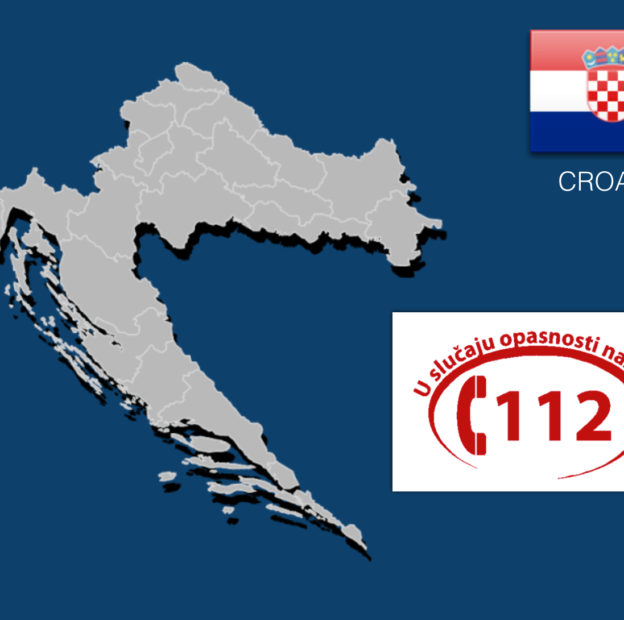
DIAL 112 TO CALL AN AMBULANCE IN CROATIA
- Ambulances are staffed by physicians and nurses with limited emergency care training
- Demand for emergency care is far greater than resources available
- A need for layperson prehospital providers (i.e., Paramedics and EMTs) has been proposed as solution to chronic EMS personnel shortages
HOW CAN I CALL AN AMBULANCE IN CROATIA?
DIAL 112 TO CALL AN AMBULANCE IN CROATIA
After speaking with a dispatcher, one of several teams may be sent to your location depending on the severity of the incident:
- EMS Team – Includes one doctor and two nurses RNs who will diagnose and treat on-scene, and coordinate with other providers if transport is necessary
- On-Call EMS Team – Same as EMS Team, except one nurse instead of two
- Emergency Transport Team – Two nurses who provide transport from the scene of the emergency to a facility, accompanied by a doctor as needed
Not necessarily. There are four major cities with EMS Centers (Zagreb, Rijeka, Split, Osijek) covering 35% of country’s population. Outside major cities, there are 54 County Health Centers (as of 2003) that have one or two 24-hour ambulances with an additional ambulance for non-urgent transport. These cover 64% of the country’s population. In areas with a population of less than 30,000, there are smaller county health centers/health stations where emergency care is provided by on-call family physicians, covering about 2% of country’s population. “In smaller cities and rural areas, the EMS frequently serves as a substitute for the primary health care that should be provided by primary care physicians. This burdens EMS doctors with non-urgent care and leaves less resource for real emergencies” (Hunyadi 2006).
Historically,
GROUND AMBULANCE IN CROATIA
AIR AMBULANCE IN CROATIA
In disaster, EMS agencies work in coordination with Crisis Headquarters of the Ministry of Health and Social Affairs.
Yes. Like France, Germany and many other European countries, you’re likely to be treated by a physician and nurse if in an ambulance in Croatia. However, “most of the doctors are inexperienced and have inadequate education in emergency medicine. These jobs are frequently considered as temporary prior to commencing residency training in established specialties. … Although there is a local expectation that physician staffed ambulances will continue to play a role in the EMS there is a need to bring other ambulance staff up to EMT and Paramedic level” (Hunyadi, 189)
TRAINING
Doctors and nurses are required to complete basic EMS education prior to working on the ambulance in Croatia. In 2002, the Croatian Resuscitation Council was founded to oversee emergency medical training in the country, with organizational and financial support by the Croatian Ministry of Health. Courses provided included ALS, ILS, BLS and EPLS and plans existed “to train policemen, firemen, flight attendants, security guards, and lay people” (Hunyadi 2006).
GROUND AMBULANCE IN CROATIA
AIR AMBULANCE IN CROATIA
Helicopter EMS has been organized by various agencies since 2000; mainly used for inter-facility and neonatal transfers or as primary transport service during tourist season.
- Croatia Mountain Rescue Service (HGSS – “HrvatskaGSS) is a volunteer, not-for-profit organization that specializes in search and rescue that can be reached by dialing 112.
Nearly entire population is covered by tax-funded basic health insurance making prehospital care free to citizens.
ADDITIONAL INFO
Common Emergencies in Croatia
Vaccinations for Croatia
According to the US Centers for Disease Control and Prevention (CDC), different groups of travelers will require different vaccinations for travel in Croatia:
- All Travelers
- Measles-mumps-rubella (MMR) vaccine
- Diphtheria-tetanus-pertussis vaccine
- Varicella (chickenpox) vaccine
- Polio vaccine
- Your yearly flu shot
- Most Travelers
- Hepatitis A
- Typhoid
- Some Travelers
- Hepatitis B
- Rabies
Read more about travel in Croatia at the CDC website: https://wwwnc.cdc.gov/travel/destinations/traveler/none/croatia/ (Last accessed: Aug. 7, 2017)
- Antoljak T et al: “A plea for Croatian trauma system.” Injury. 2013;44 Suppl 3:S3-6.
- Babalola OR et al: “Pattern of emergency room mortality among road traffic crash victims.” Injury. 2015;46 Suppl 6:S21-3.
- Hunyadi-Anticevic S: “EMS System in Croatia.” Resuscitation 2006;68:185-91.
- Klasan A et al: “Predictors of lower work ability among emergency medicine employees: the Croatian experience.” Emergency Medicine Journal. 2013;30(4):275-9.
- Marusic A: “Croatia restructures its emergency medicine system.” The Lancet 2002;359(9320):1838
- Novak K et al: “Pain to hospital times after myocardial infarction in patients from Dalmatian mainland and islands, southern Croatia.” Croatian Medical Journal. 2010;51(5):423-31.
- Sklebar D et al: “Analysis of the key issues in the organization of emergency care for stroke and heart attack patients in Bjelovar-Bilogora County.” Acta Clin Croatia 2013;52(2):165-71.
- World Bank Group: In Croatia: Upgrades to the Emergency Medical System Saves Lives (2013)
WORLD BANK VIDEO:
“UPGRADES TO THE EMERGENCY MEDICAL SYSTEM SAVES LIVES IN CROATIA”
SCOREBOARD
% of Seriously Injured Transported by Ambulance in Croatia, 2013
[Source: 2013 Global Status Report on Road Safety, WHO]
ROAD TRAFFIC INJURY DEATHS, 2015
(PER 100,000 POPULATION)
[Source: 2015 Global Status Report on Road Safety, WHO]
REPORTED HOMICIDES, 2012
(PER 100,000 POPULATION)
[Source: 2014 Global Status Report on Violence Prevention, WHO-UNDP]
OFFICIAL TWITTER FEEDS
HRVATSKA GSS (HGSS)
CROATIAN MOUNTAIN RESCUE SERVICE