

AT-A-GLANCE
DIAL 192 TO CALL AN AMBULANCE IN BRAZIL
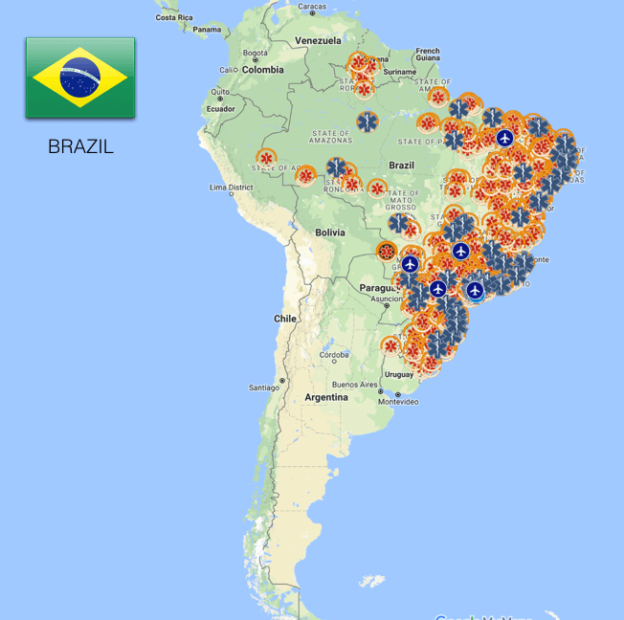
- The past 10 years has seen a rapid expansion of the public EMS systema, “SAMU 192,” now active in all Brazilian states with 175 call centers covering 1,955 municipalities — approximately 65% of Brazil’s total population
- The government’s goal is to provide access to SAMU 192 for 100% by 2018
- There is a substantial and growing presence of private sector EMS providers, largely for transfers and subscription-based emergency care at home (Phone numbers listed below)
- Despite successes of SAMU 192, there are still high rates of transport to hospital via private vehicle across the country
HOW CAN I CALL AN AMBULANCE IN BRAZIL?
The toll-free number for emergency ambulance services in Brazil is 192.
Yes, mostly. (Bloem, 9) For a large proportion of the country calls to 192 are received at a Regulation Center where Communication Operators take calls (acting as medical regulation assistants) and identify the nature of your emergency, immediately transferring call to a dispatching physician. The physician then determines appropriate resource response:
- Can refer caller to public health center
- Mobilize BLS and/or ICU-ALS ambulance
The physician remains in communication with the public hospital and keeps track of bed availability.
GROUND AMBULANCE IN BRAZIL
ALAGOAS
Maceió
- Alerta Médico: +55 82 3221-5555
- Prosaúde Maceió: +55 82 98191-9090
- SOS Unimed: +55 82 3597-2200
- Transaúde: +55 82 99971-7778
AMAZONAS
Manaus
- Bio Care: +55 92 3584-4136
- Manaus Resgate: +55 92 99357-4354
- Salvare: +55 92 3237-9660
- Vida Resgate: +55 92 3081-2456
BAHIA
Salvador
- Cuidabem: +55 71 3276-4964
- Disque Ambulância: +55 71 3371-5058
- Expressmed Emergências Médicas: +55 71 3276-3402
- Unividas Remoçes: +55 71 4114-0120
- Vitalmed Medical Emergency Services Ltda: +55 71 2202-8686
Vitória da Conquista
- Ultravida Ambulâncias: +55 77 3429-6000
CEARÁ
Caucaia
- Nordeste Emergências e Soluçes Médicas: +55 85 3387-1950
Fortaleza
- Anjos do Resgate-Emergências Médicas: 2675-9673 / 2674-7398
- Easy Life Emergências Médicas: +55 85 3048-5300
- EMN – Emergências Médicas do Nordeste: +55 85 3307-8000
- EMS Ambulâncias: +55 85 3253-0404
- Grupo Sat Atendimento Médico: +55 85 3261-2220 / +55 85 4009-0909
- Unicare Emergency: +55 85 3452-2999
- VIP Saúde: +55 85 3231-4400
DISTRITO FEDERAL (BRASILIA)
Guará
- Samedi: +55 61 3401-1106
- WMED UTI-Móvel: +55 61 3567-8863
Riacho Fundo I
- Samedi: +55 61 3401-1106
Saa Qd 1
- Vida UTI Móvel: +55 61 3248-0008
Sobradinho
- isLife: +55 61 4101-2431
Taguatinga
- Saúde & Vida Remoçes: +55 61 3548-7512
ESPIRITO SANTO
Guarapari
- S.O.S. Vida Emergências: +55 27 3262-9375
Serra
- Remocenter: +55 27 3064-1801
Vila Velha
- Proviva: +55 27 3063-7372
- Vitória Emergências: +55 27 3329-4242
Vitória
- Nunes Remoçes Emergências Médicas: +55 27 3323-3945
- SANSIM: +55 27 3324-1000
- Save Remoçes: +55 27 3200-3886
GOÍAS
Goiânia
- Ambulância Anjos da Guarda: +55 62 98485-6245
- Flash Med Uti Móvel: +55 62 3093-3100
- SOS Vida: +55 62 3941-9197
- Vida Goiás UTI Móvel: +55 62 3281-3030
MARANHÃO
São Luis
- Clinica Vitalmed: 42-3215
- SAFEMED: +55 98 3312-3152
- URGMED: +55 98 3231-8008
MINAS GERAIS
Belo Horizonte
- Disque Ambulância: +55 31 3221-5190
- Mater Dei: +55 31 3292-6000
- Medical Save Ambulâncias: +55 31 3463-7222
Curvelo
- Unimed Gerais de Minas: +55 38 3722-3198
Pouso Alegra
- Unimed Sul Mineira: +55 35 3449-1800
Pte Nova
- Unimed Ponte Nova: +55 31 3817-2314
Uberlândia
- Mais Saúde Ambulância: +55 34 99972-4963
- Phoenix Serviços Médicos: +55 34 3219-5550
MATO GROSSO DO SUL
Campo Grande
- Pro Mais Saúde: +54 67 3043-0333
- QualiSalva: +54 67 2106-1545
Dourados
- Qualicare: +54 67 9955-3935
MATO GRASSO
Cuiabá
- Help Vida: +55 65 3622-0000
- S.O.S Resgate: +55 65 3052-0101
PARÁ
Belém
- SouTransVida: +55 91 98145-0070
Marabá
- LEX Ambulância: +55 94 3322-2604
PARAÍBA
Campina Grande
- Transvida Ambulancia Particular: +55 83 98869-9434
João Pessoa
- S.O.S. Ambulância: +55 83 3221-2525
- Transmed: +55 81 3426-8247
PARANÁ
Curitiba
- Brasil Emergências Médicas: +55 41 99527-0745
- Disk Ambulância: +55 41 3255-3126
- Ecco Salva Emergências Médicas: +55 41 3242-1212
- Imperador Emergências Medicas: +55 41 99708-6975
- Plus Santé: +55 41 3342-5900
- Summus Emergências: +55 41 3071-0699
- Vida Emergências Médicas: +55 41 3343-5151
Pinhais
- A Emergências Médicas: +55 41 3557-0010
Ponta Grossa
- Unimed Ponta Grossa: +55 42 3220-3900
Toledo
- Ambulâncias Previna: +55 45 99919-1386
Umuarama
- Same Ambulância: +55 44 3622-2727
PERNAMBUCO
Petrolina
- Transmed: +55 81 3074-3213
Recife
- Ambulancia Recife: +55 81 99600-0099
- Mais Vida Serviços de Saúde: +55 81 3061-0564
- Safety Med: +55 81 3034-5002
- Transmed: +55 81 3074-3213
São Lourenço da Mata
- Disk Ambulância: +55 81 3525-0555
PIAUÍ
Teresina
- Transmed Ldta: +55 86 3234-8778
RIO DE JANEIRO
Barra de Tijuca
- Grupo Safety: +55 21 2446-4856
Belford Roxo
- Life Line Saúde: +55 21 2776-4901
Benfica
- Resgate Plus: +55 21 3860-2673
Campo Grande
- Express Remoçes: +55 21 2415-6244
- RM Resgate Médico: +55 22 2724-2335
- Unimed Campos: +55 22 2101-0650
Grajau
- ABC Remocor: +55 21 2570-3030
Niterói
- Lefe Ambulâncias: +55 21 2704-4447
São Cristóvão
- SAVIOR Medical Service: +55 21 3171-3000
- Vida Medical Emergencies: +55 21 3248-3030
Taquara
- Grupo Safety: +55 21 2446-4866
Vila Isabel
- CTICOR: +55 21 2587-5000
RIO GRANDE DO NORTE
Natal
- Natal Resgate: +55 84 98801-2512
- PRESAE: +55 84 3091-3911
- Translife: +55 84 3231-5442
RIO GRANDE DO SUL
Caixas do Sul
- Resgate Sul Emergências Médicas: +55 54 3028-8524
Porto Alegre
- Ambulância SOS Vida: +55 51 3228-0624
- MAE Emergências Médicas: +55 51 3332-8584
- Pró Vida Remoçes: +55 51 3339-6011
- Remosul Ambulâncias: +55 51 3318-4503
- RS Ambulâncias: +55 51 3384-4438
RORAIMA
Porto Velho
- Instruaud: +55 69 3222-6281
- Life Emergências Médicas: +55 69 3212-1008
SANTA CATARINA
Criciúma
- Lan Ambulâncias: +55 48 99979-9668
- Policlínica Medicar: +55 48 9982-6043
Florianópolis
- Help Emergências Médicas: +55 48 3031-2900
Itajaí
- Plantomed: +55 47 3348-6269
Joinville
- Help Emergências Médicas: +55 47 3026-8200
- Ideal Emergências Médicas LTDA: +55 47 3433-2883
São João
- Homedical: +55 47 99223-2300
São José
- Homedical: +55 47 99223-2300
São Pedro de Alcântara
- União Urgências: +55 48 3277-0067
SERGIPE
Aracaju
- D’Ávilamed Emergências Médicas: +55 79 3217-8085
- MedSalva Emergências Médicas: +55 79 3211-4255
- Prosaúde: +55 79 3211-9900
SÃO PAULO
Barra Funda
- Bem Emergências Médicas: +54 11 3871-7600
Bela Vista
- Remoçes Fadinis: +55 11 3141-0467
Bom Retiro
- Ambulância Globo Vida: +55 11 2362-4100
- Med Salva Urgências Médicas: +55 11 3225-2255
Brás
- Dez Emergências
Brooklin
- JP-Salva
Campinas
- Bem Emergências Médicas: +55 11 3871-7600
- Medicar Emergências Médicas: +55 11 3348-1008
Campos Elíseos
- Doctor Emergency Ltda: +55 11 3427-0471
Casa Verde
- Equilíbrio Ambulâncias: +55 11 2337-7338
- Manchete Médica Ltda.: +55 11 3393-7310
Cruzeiro
- Anjos de Resgate: +55 12 3211-7790
Jd Cruzeiro
- Vital Med Clínica Medica: 222-8888 / 345-8888
Osasco
- Intensiva Remoçes Terrestres: +55 11 3604-2400
Pinheiros
- Ambulância SP: +55 11 7741-5471
Santos
- Bem Emergências Médicas: +55 13 3221-2227
- Brasil Emergências: +55 13 3324-0200
São José dos Campos
- Emercor: +55 12 3942-8666
Taubaté
- Life Corp do Brasil: +55 12 3432-2222
Vila Bertioga
- MS Emergências: +55 11 2268-0490
Vila Carrao
- S.O.S. Ambulâncias: +55 11 2137-2111
Vila Formosa
- MS Serviços de Remoçes: +55 11 7822-5972
- Starex Emergencias Medicas: +55 11 2361-8295
AIR AMBULANCE IN BRAZIL
The National System for Civil Defense and Protection (Sistema Nacional de Proteção e Defesa Civil) is overseen by the Ministry of National Integration
Yes, responders on SAMU 192 ambulances in Brazil are trained, though there is less certainty about qualifications with many smaller private EMS agencies.
For SAMU responders:
- Basic team consists of a driver and a nurse technician capable of providing basic life support and using an automated external defibrillator (AED).
- Advanced team consists of a driver, a nurse and a physician trained in advanced life support.
- Rapid support team consists of a driver, a physician and advanced support equipment to complement the basic unit team
TRAINING CENTERS
- RIO DE JANEIRO
- Rio Emergência
- SÃO PAULO
SAMU 192 services are delivered by three types of ambulance in Brazil:
- USB – Basic life support ambulance, staffed by emergency medical technicians
- USA – Advanced life support ambulance, staffed nurses and doctors
- Rapid intervention vehicles – Staffed by physicians to provide care on-scene, particularly in urban areas where congestion is high
SAMU 192 also operates air ambulances by helicopter, though not uniformly across the country. Private air ambulance in Brazil is more commonly used.
SAMU 192 services are offered to citizens free of charge, with funding provided by federal, state and municipal governments.
ADDITIONAL INFO
Currently parts of Brazil are experiencing a Yellow Fever outbreak, and the Zika outbreak is also a concern.
According to the US Centers for Disease Control and Prevention (CDC), different groups of travelers will require different vaccinations for travel in Brazil:
- All Travelers:
- Measles-mumps-rubella (MMR) vaccine
- Diphtheria-tetanus-pertussis vaccine
- Varicella (chickenpox) vaccine
- Polio vaccine
- Your yearly flu shot
- Most Travelers:
- Hepatitis A
- Typhoid
- Some Travelers:
- Hepatitis B
- Malaria
- Rabies
- Yellow Fever
Read more about travel in Brazil at the CDC website: https://wwwnc.cdc.gov/travel/destinations/traveler/none/brazil (Last accessed: Aug. 7th)
1980s – Emergency care provided by Military Fire Department (CBM) utilizing Anglo-American model
- “US model of ambulance medical care began to be used by the Military Fire Department (CBM) in the late 1980s, with such professionals working as emergency medical technicians and providing care for traumas. The state of Rio de Janeiro was pioneer in this mode of care and has remained a benchmark by virtue of other emergency care initiatives it has developed” (O’Dwyer, 2013)
SAMU Serviço de Atendimento Móvel de Urgência (Mobile Emergency Care Service)
- Three main stages of emergency care development (Machado)
- 1998-2003: Federal regulation
- “Produced the rules and defined the resources for the regulation of care services essential for tackling morbidity and mortality indicators” (O’Dwyer, 2013)
- 2000 – Report to Congress describes lack of regulation:
- “The Health Care Secretary (…) stood at the opening of congress and said that there actually was no medical emergency policy established in the Ministry and that he was open to hold discussions (…) we worked enthusiastically through congress to make a report and a national proposal to be submitted to the Ministry (O’Dwyer)
- “Communities of specialists (health professional networks and councils) pieced together alternatives for emergency medical service and were able to exert influence on the Ministry of Health in the early 2000s, resulting in the first regulatory standards being established for the field” (Machado)
- 2004-2008 – Major expansion of SAMU services
- “In Rio de Janeiro, pioneer state in pre-hospital care provided by the Fire Department, the first regionalized SAMU of Brazil, named Metropolitan II, was installed in 2004 to service 7 municipalities and almost 2 million people.” (O’Dwyer, 2013)
- 2009-Present: Implementation of stationary Emergency Care Units (UPA)
- “A proposal currently exists to expand the SAMU to cover 100% of the population by 2018.” (O’Dwyer, 2013)
- High degree of variation in the transition process from FD-based EMS to SAMU-192 strategy (O’Dwyer 2013)
- 24hr/day, any location
- Staffed by Physicians, Nurses, Nursing Assistants and Rescuers
- 70 SAMU services established/operating in Brazil (Timerman, 357)
- 320 towns in 22 states
- 1998-2003: Federal regulation
- 2015, September – Emergency Medicine officially recognized as a specialty by Brazilian government
Lead Agency: SAMU 192 is overseen by Ministry of Health but is managed locally with varying levels of support and integration with regional and state authorities.
SAMU Legislation
- DECRETO Nº 5.055, DE 27 DE ABRIL DE 2004.
- PORTARIA Nº 2.657, DE 16 DE DEZEMBRO DE 2004 (Regulação Médica)
- PORTARIA Nº 1.010, DE 21 DE MAIO DE 2012. (Implantação do Serviço de Atendimento Móvel de Urgência)
- PORTARIA Nº 1.473, DE 18 DE JULHO DE 2013
- PORTARIA Nº 356, DE 8 DE ABRIL DE 2013
OTHER AGENCIES
- General Coordination of Emergency Services (CGUE)
- National Emergency Service Steering Committee
- Brazilian Cooperative Network for Emergencies (RBCE)
- Bloem C: “Emergency Medicine in Brazil.” American Academy of Emergency Medicine 2008;15(6):9-11.
- Cardoso RG et al: “Helicopter emergency medical rescue for the traumatized: experience in the metropolitan region of Campinas, Brazil.” Rev Col Bras Cir. 2014 Jul-Aug;41(4):236-44
- Machado CV, Salvador FGF, O’Dwyer G: “Mobile Emergency Care Service: analysis of Brazilian policy (O Serviço de Atendimento Móvel de Urgência no Brasil: uma análise da política nacional).” Revista de Saúde Pública 2011;45(3):519–528.
- Nielsen K, Mock C, Joshipura M, Rubiano AM, Zakariah A, Rivara F. “Assessment of the Status of Prehospital Care in 13 Low- and Middle-Income Countries.” Prehospital Emergency Care. 2012:10;16(3):381–9.
- Nogueira LC Jr et al: “Reducing Emergency Medical Service response time via the reallocation of ambulance bases.” Health Care Management Science. 2016 Mar;19(1):31-42
- O’Dwyer G et al: “Mobile prehospital emergency care: an analysis of implementation in the State of Rio de Janeiro, Brazil.” Ciênc. saúde coletiva 2016;21(7):2189-2200.
- O’Dwyer G, Mattos RA: “The SAMU, the regulation in the State of Rio de Janeiro and integral care according to managers of the three government levels (O SAMU, a regulação no estado do Rio de Janeiro e a integralidade segundo gestores dos três níveis de governo).” Physis 2012, 22(1):141–160.
- O’Dwyer G, Konder MT, Machado CV, Alves CP, Alves RP. “The current scenario of emergency care policies in Brazil.” BMC Health Serv Res. 2013;13(1):70.
- Ortiaga AM et al: “Evaluation of the Mobile Emergency Care Service in Santa Catarina State, Brazil.” Cad Saude Publica. 2016 Dec 15;32(12):e00176714
- Semensato G, Zimerman L, Rohde LE. “Initial evaluation of the Mobile Emergency Medical Services in the city of Porto Alegre, Brazil.” Arq. Bras. Cardiol. 2011;96(3):196–204.
- Tannebaum RD, Arnold JL, De Negri Filho A, Spadoni VS: “Emergency Medicine in Southern Brazil.” Annals of Emergency Medicine 2001;37(2):223-8.
- Timerman S, Gonzalez MMC, Zaroni AC, Ramires JAF: “Emergency medical services: Brazil.” Resuscitation 2006;70:356-9.
SCOREBOARD
ROAD TRAFFIC INJURY DEATHS
(PER 100,000 POPULATION)
[Source: 2015 Global Status Report on Road Safety, WHO]
REPORTED HOMICIDES
(PER 100,000 POPULATION)
[Source: 2014 Global Status Report on Violence Prevention, WHO-UNDP]