

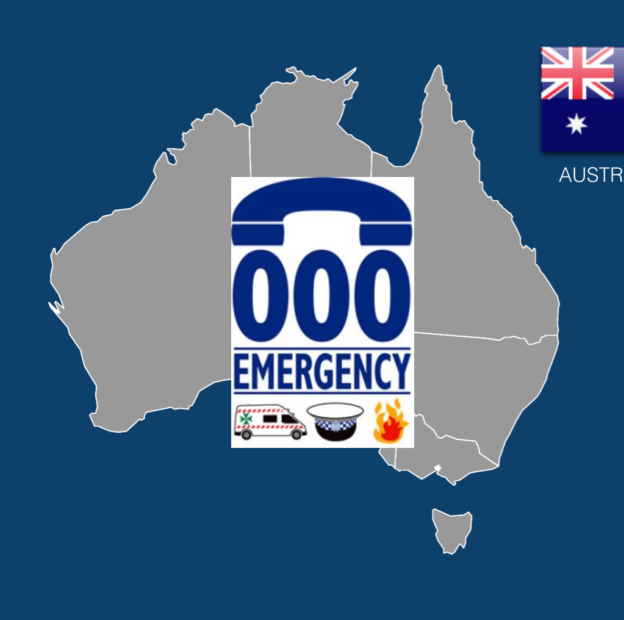
AT-A-GLANCE
DIAL 000 TO CALL AN AMBULANCE IN AUSTRALIA
- Australia boasts one of the most advanced ambulance services in the world, with among the most well-trained prehospital providers
- Access to 24-7 emergency services are available across the country, though the outback clearly presents logistical challenges
- The cost of an ambulance is approximately AUD$275-$750 unless privately insured or pensioned [Source: NSW Ambulance]
HOW CAN I CALL AN AMBULANCE IN AUSTRALIA?
The toll-free number for emergency services in Australia is 000.
Yes, mostly – the outback can be a bit isolating.
You should call 000 only, and from anywhere.
Call 000 from anywhere in the country for disasters. Operators are able to activate a host of additional disaster response services, including State Emergency Service (SES), Fire and Police Rescue, Ambulance Special Operations (SOT) and mobile hospital medical teams.
Yes, ambulance officers in Australia are trained in three levels:
- Paramedic – Will generally hold a Bachelor of Paramedicine with additional training from the designated state ambulance service. Skills include IV access, fluids, laryngoscopy, advanced airways, S8 analgesia administration.
- Intensive Care Ambulance (ICP) – Additional 1-3 years of training involving a combination of classroom theory, hospital attachments and on-road component. (Trevithick, 165). Additional skills include RSI, advanced cardiac medications, decompression of tension pneumothorax.
- Extended Care Paramedic (ECP) – Additional 1 year of training in low-acuity paramedicine involving 2 month course run by physicians and hospital placements. Skills include antibiotic prescribing, suturing and catheterisation.
If transport is required, transport is provided by ambulance, generally Mercedes Sprinter. In remote areas transport to base hospitals will be by fixed wing aircraft or helicopter. In low-acuity cases, non-transport referrals are explored.
Patients are generally transported to the closest public hospital. Bypass to major trauma centres are initiated in cases of serious injury. Other specialty destinations include burn, cardiac and pediatric centers.
Each Australian state sets its own rates for ground and air ambulance, but generally speaking a call-out fee of between AUD $300-$1000 is charged directly to the patient unless covered by private insurance or on a pension.
Read more about charges for an ambulance in Australia from each state/territory:
ADDITIONAL INFO
Common Emergencies in Australia
- Shark attacks
- Drownings
- Floods
- Spider and snake bites
Recommended Vaccinations for Australia
According to the US Centers for Disease Control and Prevention (CDC), different groups of travelers will require different vaccinations for travel in Australia:
- All Travelers:
- Measles-mumps-rubella (MMR) vaccine
- Diphtheria-tetanus-pertussis vaccine
- Varicella (chickenpox) vaccine
- Polio vaccine
- Your yearly flu shot
- Some Travelers:
- Hepatitis A
- Hepatitis B
- Japanese Encephalitis
- Rabies
- Yellow Fever – “There is no risk of yellow fever in Australia. The government of Australia requires proof of yellow fever vaccination only if you are arriving from a country with risk of yellow fever. This does not include the US.” See full list here.
Read more about travel in Australia at the CDC website: https://wwwnc.cdc.gov/travel/destinations/traveler/none/australia/ (Last accessed: Aug. 7, 2017)
The first recognised ambulance service in New South Wales, known as the Civil Ambulance and Transport Brigade, commenced operations on 1 April 1895. The first ambulance station was a borrowed police station in Sydney staffed by two permanent officers. Patients were transported on hand-held stretchers and hand-litters.
In the state of Victoria the first motor vehicle ambulance began operation in 1910, responding to 700 of the 4000 ambulance calls in the first year. 1916 saw St John Ambulance relinquish responsibility and the Victorian Civil Ambulance Service (VCAS) was formed, solely relying on public donations.
More than 100 years on in NSW the ambulance service employs over 4,000 staff, operating from 266 stations across the State, with over 800 ambulances, 300 support vehicles, four fixed wing aircraft and nine helicopters.
Ambulance services in Australia are overseen by the state/territory department of health. In two states – Western Australia and Northern Territory — the ambulance services are contracted to St John Ambulance.
- Boyle MJ, Smith EC, Archer FL: “Trauma incidents attended by emergency medical services in Victoria, Australia.” Prehospital and Disaster Medicine 2008;23(1):20-8.
- Trevithick S, Flabouris A, Tall G, Webber CF: “International EMS systems: New South Wales, Australia.” Resuscitation 2003;59:165-70.
SCOREBOARD
% of Seriously Injured Transported by Ambulance in Australia, 2013
[Source: 2013 Global Status Report on Road Safety, WHO]
ROAD TRAFFIC INJURY DEATHS
(PER 100,000 POPULATION)
[Source: 2015 Global Status Report on Road Safety, WHO]
REPORTED HOMICIDES
(PER 100,000 POPULATION)
[Source: 2014 Global Status Report on Violence Prevention, WHO-UNDP]